

Sample report
The report, as it is issued.Read it the way an auditor would.
A loan audit report on a fictional file, printed by the same renderer as every report Flightline issues: the review summary, each finding with its evidence and requirement, every question the review answered, and the sealed record.
Sample loan audit report
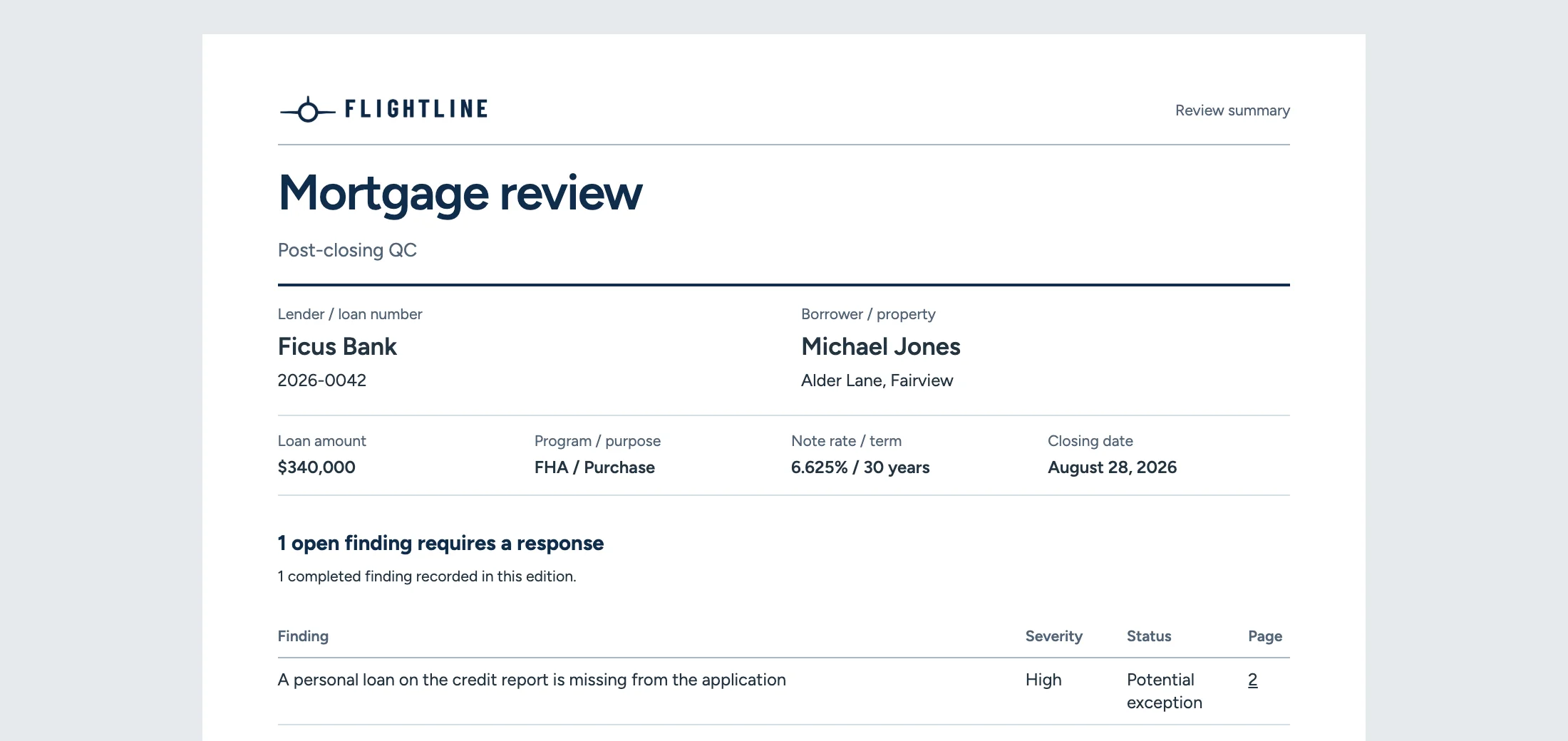
Fictional file. Names, amounts, addresses and page references are invented. The seal and QR code on a sample do not verify.
What every finding carries.So it survives the first question.
A finding is only as useful as the next person’s ability to confirm it, in your team or outside it. Before it is published, a second automated review tries to rebuild it from the documents and the guideline; a finding it cannot rebuild does not publish.
Behind the findings, the report lists every question the review answered, with its answer and page, and records how each finding was resolved. Each edition is sealed.
What we found
Stated in plain language, so nobody has to decode a rule code.
What would resolve this finding
The documentation or correction that would clear it, so the file moves instead of stalling.
Why this matters
The effect on the loan, with the arithmetic shown: from the figure underwritten to the figure the file supports.
Evidence used
Every fact points to the document and page it came from, so anyone checking it confirms it in minutes.
Requirement
Cited to its section as it stood on the review date, so the finding holds up with an investor, insurer or auditor.
Mapped to the reporting requirementseach agency and investor sets.
Each agency says what a QC finding must record and how findings reach management. Here is how the loan audit report maps to each one. These are mappings for your review, not certifications.
| Source | What it asks of QC findings and reporting | Where the report carries it |
|---|---|---|
| Fannie MaeSelling Guide D1-1-01, D1-1-03, D1-3-01 | Every defect categorized by severity, with the highest level reserved for loans not eligible as delivered. Written reports to management each month, in consistent defect categories and severity levels, with compliance-with-law defects kept apart from underwriting and eligibility defects. Defects communicated to the business units responsible, and a written action plan when trends appear. The post-closing cycle, rebuttal included, completed within 90 days. | Each finding carries its severity and status, the evidence by page and the requirement cited to the section. How each finding was resolved is recorded in the report’s resolved history. The monthly QC report rolls findings up by program, channel, region, review area and test. |
| Freddie MacSeller/Servicer Guide Chapter 3402, Section 3402.3 | Reviews documented in writing. Results reported in writing to senior management within 90 days of selecting the files. Findings that affect the acceptability or eligibility of a loan analyzed, and corrective action started. | A written finding with evidence by page and the requirement cited. The submission and publication dates are on the cover, and each edition is sealed, so the record of what was reported, and when, is fixed. |
| FHAHUD Handbook 4000.1, V.A.2.c and V.A.3.b; Appendix 8.0, FHA Defect Taxonomy | Each loan reviewed rated for risk, from low to material. Findings judged material or not, and mitigated or not. Initial findings reported within 60 days of selection, to senior management within 30 days after, and a final report with corrective actions, a timetable and follow-up within 60 days after that. FHA rates its own findings by defect area and severity tier. | Each finding carries its severity, its evidence and the HUD requirement cited to the section. Every question the review answered is listed with its answer and page, the resolved history records how each finding was cleared, and the dates on the cover anchor the reporting clocks. |
| VALenders Handbook, VA Pamphlet 26-7, Chapter 1, Topic 14 | Written notice of deficiencies to senior management at least quarterly. Prompt corrective action, with the deficiencies and the actions taken documented. Violations, false statements and program abuse reported to VA, and review findings furnished to VA on demand. Discrepancies in the loan resolved and documented in writing. | Each deficiency is stated with its evidence and the requirement, and the resolved history documents how it was resolved. Issued reports are sealed and can be produced when VA asks for review findings. |
| USDAHB-1-3555, Chapter 3, paragraph 3.3.A and Attachment 3-A | Non-compliance reported to the highest levels of management, monthly or at least quarterly. Set timeframes for review and follow-up. Violations, false statements and program abuse reported to the appropriate authorities. | Each finding states the non-compliance against the cited handbook section, with its evidence. Findings roll into the monthly QC report to management. |
| Ginnie MaeMBS Guide (5500.3, Rev. 1), Chapter 2, Part 10 and Chapter 3, Part 9 | Issuers maintain a quality control plan for origination, underwriting, servicing and secondary marketing, and disclose the actions taken on the findings of their most recent quality control audit. Pooled loans are FHA, VA, USDA or PIH loans, so the loan-level review follows the insuring agency above. | Findings and how each was resolved are kept together in each sealed edition, so the record of findings and responses can be produced for an issuer review. |
Requirements are cited as they stood on the review date. Your own QC plan, severity scale and overlays are included in the same review and cited the same way. The QC plan, the reporting clocks and self-reporting to each agency stay with you.
Send us a fileyou’ve already closed.
The fastest way to judge Flightline is on a loan your team already knows. We’ll show you what it finds, and you decide whether it holds.